What happens when a wild animal becomes a captive star under the spotlight of celebrity culture?
by Raf de Bont
Issue: Wild rhinos caught and transported, moved from their natural habitat, turning into captive ‘celebrity animals’
Time Period: 1948
Places: Rumuruti, Kenya
Image: Carr-Hartley seated on a rhino (most probably Gus) at his game farm, 1948. Source: Rhino Resource Center.
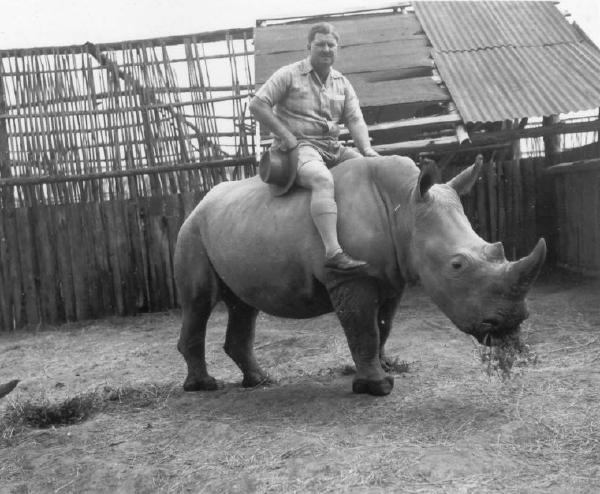
This module examines the case of a celebrity animal to explore how animal lives, and the meanings attached to them, shift when they are captured in the wild, transported, and exhibited for paying audiences. The striking image shows Thomas Carr-Hartley—a Kenya-based settler, animal trapper, and dealer—photographed at his game ranch in Rumuruti, ‘riding’ a rhinoceros, “Gus,” that he had captured in Anglo-Egyptian Sudan who he displayed to tourists at his ranch. Later, Gus was first transported to various zoological institutions around the world, including Hamburg Zoo (Germany), Southampton Zoological Gardens (UK), and Lion Country Safari in Loxahatchee, Florida (USA). As such, he circulated through the global network of commercial zoos.
By tracing Gus’s history of capture, transport, and display, we gain insight into what is transformed—and what is lost—when wild animals are moved across the world. Violent capture and relocation disrupts ingrained habits, ecological knowledge, relationships, and the meanings ascribed to rhinos by local communities in their regions of origin.
Once relocated, new meanings and relationships were imposed upon these animals. Each of Gus’s new “owners” constructed a celebrity status around him, capitalizing on his presence to draw paying crowds and to serve as an emblem of the value of conservation and captive breeding efforts. Other captured animals had similar experiences, and some examples are discussed in the article. Capture and relocation profoundly altered the animals themselves, reshaping their bodies and behaviour, but also both how they were perceived and how they related to the human worlds around them.
Guiding Questions
- What kind of human-animal relationship does this image portray?
- How does the environment at Rumuruti, as seen in the image, contrast with the savannah landscape where Gus was originally captured?
- What impact might the transition from the wild to Rumuruti — and subsequently to multiple zoological theme parks — have had on Gus’s life? How might these shifts have influenced the meanings projected onto him?
Homework Assignment
Find a picture, film clip, or journalistic piece about another celebrity animal and situate this media within the historical context in which it gained meaning. Retrace the life story of the animal in question, map its movements, and examine how its life was shaped by processes of capture, transport, exhibition, or conservation.
 Read the full chapter "Flying Rhinos Paul, Chloe, and the Making of the Conservationist Zoo"
Supplementary Sources
Readings
Matthew Chrulew, “Managing Love and Death at the Zoo: The Biopolitics of Endangered Species Preservation,”Australian Humanities Review 50 (2011): 137–157.
Erica Fudge, “Animal Lives,” History Today 54, no. 10 (2004): 21–26.
Andrew J. P. Flack, “Science, ‘Stars’ and Sustenance: The Acquisition and Display of Animals at the Bristol Zoological Gardens, 1836–c. 1970,” in Wild Things: Nature and the Social Imagination, ed. William Beinart, Karen Middleton, and Simon Pooley (Cambridge: White Horse, 2011), 163–184.
Media
The Last Male on Earth, directed by Floor van der Meulen (Tangerine Tree, 2019), film.