How and why did circuses move animals?
by Marianna Szczygielska
Issue: Captivity
Time Period: Late nineteenth to mid-twentieth century
Places: Central Eastern Europe
Image: Friedländer's poster for Circus Sarrasani (1907). The circus arriving at the station. Source: De theatercollectie Allard Pierson Museum, University of Amsterdam, object number: TEY0010001851.
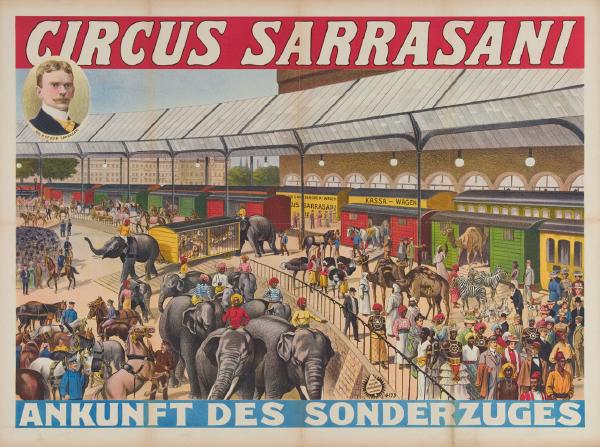
This teaching module focuses on the tension between animal captivity and mobility as illustrated by the exchange of specimens between circuses and zoos at the turn of the twentieth century. Circuses are often contrasted with zoos when it comes to their purpose, animal involvement, and animal welfare standards employed. While both institutions are premised on animal captivity, circuses often uniquely required captive animals to travel. Many elephants transported to Europe at the turn of the twentieth century started their performing careers in circuses and ended them in zoological gardens. This article looks at the circulation of affect and knowledge between these two modern institutions specializing in the display of exotic animals. Building on the animal biography method, it follows an Asian elephant named Little Cohn on his journey between two German circuses and one Polish zoo. Students will learn what such reconstruction of a single elephant’s journey tells us about the infrastructures of mobility that sustained various forms of animal captivity. In contrast to zoos, circuses have only recently started to be analyzed from the history of science and technology perspectives as venues both promoting and benefiting from innovations. The trajectories of the global trade in living animals highlight the role of traveling circuses in supplying zoos with specimens, as well as the colonial appropriation of animal bodies and labor. Through the reflection on the animal biography method, the article provides tools for studying more-than-human agency, colonial animal trade, and the tension between captivity and mobility. The teaching module includes a circus poster from the theater collection of the Allard Pierson Museum, part of the University of Amsterdam. It was produced by the Hamburg printshop of renowned lithographer Adolph Friedländer (1851–1904), best known for creating intricately detailed advertising posters for artists, circuses, and vaudeville performers—often featuring vivid depictions of animal life.
Guiding Questions
- In this poster, can you identify who was the “exotic” attraction of the spectacle? What does the portrayal of animals and people tell us about their role in the circus?
- What are the elephants doing in this image? What kinds of work are they performing? Who accompanies them?
- Do you think animals were part of the mobility infrastructure of the circus? Explain why and how.
Homework Assignment
Choose any individual animal living in a zoo or circus in the past or present and write a short biographical note based on online sources. You may include visuals. In addition, reflect on the following questions: What can we learn about the life and death of an animal from archival sources, media, and visual representation? What can such a microhistory tell us about the zoo as an institution? Which species and which animals leave no trace in the archives? How has colonialism affected the trade in exotic animals? What are the benefits and limitations of the animal biography method?
 Read the full chapter "Animating Capture, A microhistory of Elephant Mobility"
Supplementary Sources
Readings
Susan Nance, Entertaining Elephants: Animal Agency and the Business of the American Circus, illustrated ed. (Baltimore: Johns Hopkins University Press, 2013).
Susan Nance, “The Troubling Origins of the Circus Elephant Act” (guest post), Johns Hopkins University Press News, March 12, 2015.
Andrea Ringer, Circus World: Roustabouts, Animals, and the Work of Putting on the Big Show (University of Illinois Press, 2024).
Peta Tait, “History of Circus Animals,” in Handbook of Historical Animal Studies, ed. Mieke Roscher, André Krebber, and Brett Mizelle, 457–470 (Berlin: De Gruyter Oldenbourg, 2021).
Kari Weil, “Men and Horses: Circus Studs, Sporting Males and the Performance of Purity in Fin-de-Siècle France,” French Cultural Studies 17, no. 1 (2006): 87–105.
Multimedia
Short archival film, Arrival of circus elephants, France. 1934.
A DJ set for zoo elephants. Gooral, Birma, and Toto in Wrocław Zoo.