How Do Emotional Bonds Shape and Constrain Animal Mobility?
by Rebecca J. H. Woods and Shira Shmuely
Issue: Role of emotion in restricting and enabling movement.
Time Period: 1930–1933
Places: Cameroon; Long Island, New York; Brookfield Zoo, Chicago
Image: The Maternal Instinct (1933), Natural History Magazine, vol. 33, no. 6. From the Robert Mearns Yerkes Papers, Beinecke Library, Yale University.
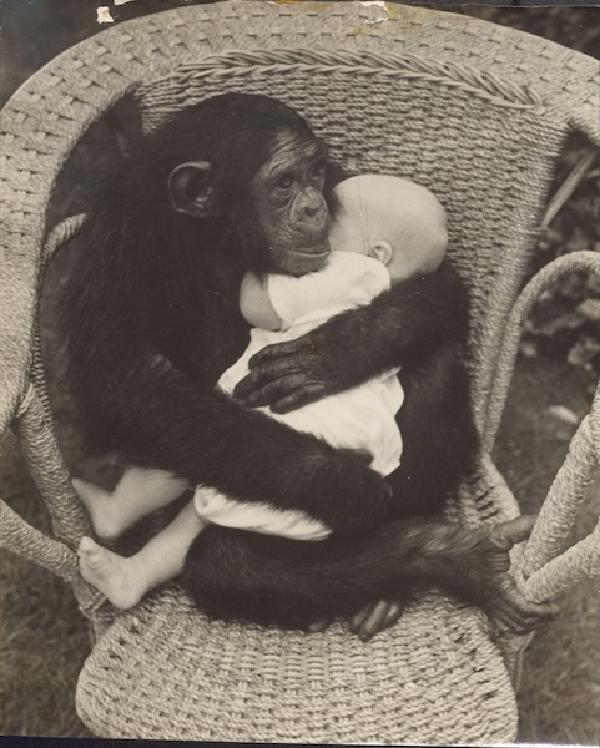
This teaching module uses the photograph titled “The Maternal Instinct” (1933) to examine “affective mobility”—the emotional processes that enabled and ultimately limited the movements of Meshie Mungkut, a Cameroonian chimpanzee raised in 1930s America. American naturalist and collector Henry Raven took this photo of Meshie holding his daughter Marie and featured it in a 1933 article in Natural History, a magazine published by the American Museum of Natural History. Students will analyze how affective ties, portrayed in visual and narrative media, shaped Meshie’s transformation from orphan to cherished companion, and eventually, to objectified zoo specimen. The image of Meshie cradling Mary Raven exemplifies how love, care, and domestication could simultaneously offer opportunities for movement while masking deeper structures of constraint, violence, and colonial extraction. Through close reading of this visual source, students will interrogate how emotional relationships between humans and nonhuman animals influence scientific practices, public spectacles, and historical memory. This case also invites broader reflection on the ethics of interspecies intimacy and how representations of animals as family members can both challenge and reinforce dominant social orders. Supplemental readings and class discussions will place Meshie’s story in the context of primatology, colonial science, and early wildlife filmmaking, emphasizing how mobility—whether physical, emotional, or social—is deeply entangled with power.
Guiding Questions
- How did affective ties facilitate Meshie’s initial transoceanic journey and later confine her physically and emotionally? How does Meshie’s life story challenge or complicate narratives about domestication, science, and care?
- How did the domestic space of the Raven household serve as both a family home and a site of scientific experimentation? How did Meshie’s life blur the boundaries between home, laboratory, and fieldwork in early 20th-century scientific practice?
- How was Meshie’s “maternal instinct” staged, interpreted, and used to produce knowledge about human-animal similarities? What role did emotions - such as affection, care, or grief - play in producing scientific knowledge about nonhuman animals? How did the image function as scientific evidence, and how can it shape public perceptions of animal behavior and intelligence?
Homework Assignment
Identify another instance (animal or human) where emotions played a critical role in facilitating or restricting mobility. Write a brief analysis comparing it to Meshie’s experiences, focusing on how feelings like affection, pity, or fear influenced movement or confinement.
 Read the full chapter "Chimpanzee Child The Affective Mobility of Meshie Mungkut in 1930s America"
Supplementary Sources
Donna Haraway, Primate Visions: Gender, Race, and Nature in the World of Modern Science (New York: Routledge, 1989) (selections).
William K. Gregory and Henry Cushier Raven, In Quest of Gorillas (New Bedford, MA.: The Darwin Press, 1937).
“‘Project Nim’: A Chimp’s Very Human, Very Sad Life,” Fresh Air (NPR, July 20, 2011).
Georgina M. Montgomery, Primates in the Real World: Escaping Primate Folklore and Creating Primate Science (Charlottesville: University of Virginia Press, 2015).