How has astronomy been shaped by cultural perceptions of human-animal relations?
by Aida Alavi
Issue: Cultural astronomy, animal representation
Time Period: Tenth century (al-Sufi) and seventeenth century (Safavid manuscript)
Places: Arabian desert; Persianate world; manuscript production centre (Mashhad)
Image: Camel constellation, Persian translation of The Book of Fixed Stars, (Kitab Suwar al-Kawakib al-Thabita), from The New York Public Library, Spencer Persian MS 6, fol. 42r.
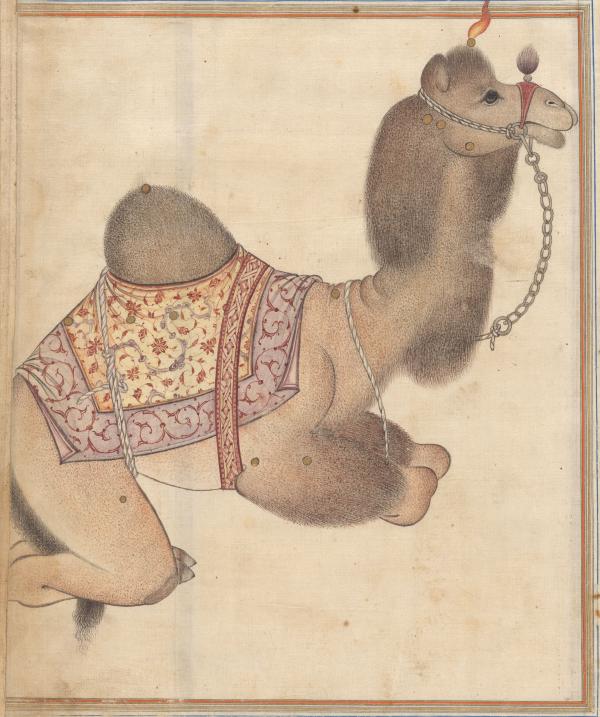
This teaching module examines a seventeenth-century illustration of the Camel constellation from The Book of Fixed Stars (Kitāb Ṣuwar al-Kawākib al-Thābita) by the tenth-century Persian astronomer ʿAbd al-Raḥmān al-Ṣūfī. Building on the star catalog of Claudius Ptolemy (Almagest), al-Ṣūfī preserved the Greek constellations in his work while incorporating ancient Arabic star traditions, including the Arabian Horse and the Camel.
Students explore how the camel, an animal central to Bedouin life in its role as a pack animal, appears in the sky as a celestial guide, revealing how cultural environments mediate scientific observation and shape astronomical knowledge.
Unlike classical Greek constellations with developed mythological narratives, ancient Arabic constellations such as the Camel often lack written myths and are instead deeply rooted in oral traditions and environmental familiarity. This has contributed to the marginal status of such constellations. It also explains why, among more than one hundred known copies of al-Ṣūfī’s treatises, the Camel illustration remains exceptional, and why this illustration may be the only representation of the Camel by itself. The Camel also overlaps with and has been illustrated alongside neighboring constellations such as Cassiopeia and Andromeda, the latter also known in Arabic as the She-Camel (al-Nāqa), reflecting the persistence and adaptation of local astral traditions within new systems of knowledge.
Using this visual source, students analyze how astronomy is shaped by environment and cultural identity. The module highlights how desert populations projected familiar animals into the night sky, producing alternative celestial mappings. By examining this unique manuscript page, students reflect on how images function simultaneously as scientific tools and cultural artifacts.
Guiding Questions
- In what ways does this example challenge or expand your ideas about science? Do you see astronomy as universal knowledge, or as something shaped by cultural and environmental contexts? Explain your reasoning.
- Why are the stars in the constellation indicated visually with points but left without names or precise coordinates, unlike those in the Ptolemaic constellations?What might this difference suggest about how the constellation was used or understood?
- What might be the meaning of the flame above the Camel’s head? Could it represent a symbolic element, a practical marker, or an overlap with another constellation?
- Try researching other representations of this constellation. Why do you think the Camel is sometimes illustrated as seated and other times as standing?
Homework Assignment
Identify another constellation or celestial figure shaped by local culture. Compare it to the Camel constellation, focusing on how environment and daily life influence the ways humans map and interpret the sky. Write a short comparison of about 500 words.
Supplementary Sources
Alavi, Aida. “Between Art and Science: The Legacy of the Manuscripts of al-Ṣūfī and the Astronomy of Safavid Iran (1501–1722).” In The Stars of Samarkand: Commentaries on the Facsimile of the Book of Fixed Stars by ʿAbd al-Raḥmān al-Ṣūfī, edited by Anna Caiozzo. Müller und Schindler, 2026.
Caiozzo, Anna. “Heavenly Camels: Some Survivals of Ancient Bedouin Beliefs and Legends in Oriental Illustrated Manuscripts.” In Vol. 1 of The Camel through the Ages, edited by David Alexander. Fondation Layan, 2020.
Shopov, Aleksandar. “Hybridizing Camels in Sixteenth-Century Selanik: Mobility, Natural Knowledge, and Ottoman Debates about the Breeding of the Rumis.” Osiris 40 (2025): 197–217.