How did ducks become a mobile technology for fighting locust plagues in late imperial China?
by Yubin Shen
Issue: Biological pest control; animal labor; agricultural knowledge
Time Period: At least from the mid-eighteenth century to the present
Places: Jiangsu, Zhejiang, and Anhui, with wider connections across China, especially in water-rich regions with traditions of duck raising
Image: Releasing ducks to devour locusts, from Li Yuan, Buhuang tuce (Illustrated Book for Catching Locusts), 1759
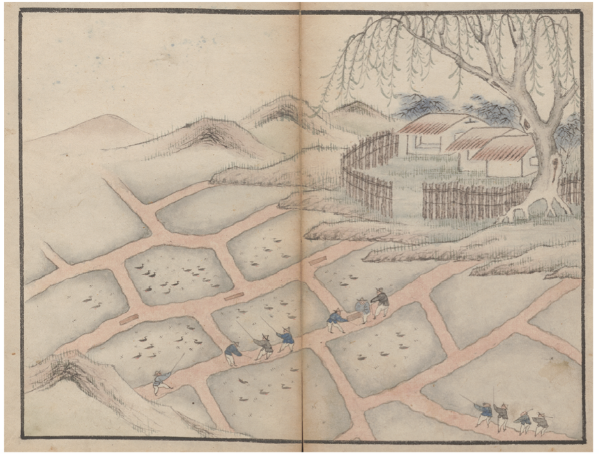
Without the accompanying text, this image is not immediately legible. At first glance, it looks like a quiet farming scene: cultivated fields, farmers standing at the edges with long poles, and a large flock of ducks moving across the plots. Only on closer inspection do the small dark specks in the fields begin to read as locusts. The small rectangular pits along the ridges are also easy to miss, but they are crucial. They point to a technique used alongside the ducks: farmers would drive locust nymphs into pits and kill them before they could mature and take flight.
Read together with the text of Buhuang tuce, however, the scene becomes much clearer. This is not simply an image of ducks eating insects. It depicts a coordinated regime of pest control in which farmers, ducks, field infrastructure, and insect life cycles were brought together. In the historical literature on locust control, ducks were valued because they could be mobilized efficiently in the fields and because, unlike human trampling, they could move through crops without doing much damage. In this sense, ducks were not just background livestock. They became a form of working animal and a living technology of biological control.
This image also opens onto a broader history of movement. As my article argues, the duck method developed through the circulation of humans, locusts, ducks, sweet potatoes, and materials across late imperial and modern China. The method became especially important in the lower Yangtze region, where locust-prone environments, abundant water, and traditions of duck raising made it workable on a large scale. What we see here, then, is not only animal mobility in the narrow sense of ducks moving across fields, but a larger agricultural and ecological system in motion.
Guiding Questions
- Why do you think is this image difficult to understand at first glance, and what changes when we read it together with its accompanying text?
- What kinds of labor are the ducks performing here? In what sense can they be understood as a technology rather than simply as farm animals?
- What qualities made ducks especially effective as anti-locust agents? Consider factors such as their feeding behavior, movement through wet fields, interactions with farmers, and effects on crops.
- How does this image connect animal movement to agricultural knowledge, pest control, and environmental management?
Homework Assignment
Choose another historical example in which animals were used to control pests or other animals. Compare it with the use of ducks against locusts in China, or with chapter 4 of Emily O’Gorman’s Wetlands in a Dry Land, where ducks were seen as pests in Australian wetlands. How were the animals mobilized, and what kinds of knowledge, landscape conditions, and infrastructures shaped their roles? Why could the same animal be valued in one context but condemned in another?
Supplementary Sources
Readings
Francesca Bray et al. Moving Crops and the Scales of History. Yale University Press, 2023.
Emily O’Gorman. Wetlands in a Dry Land: More-Than-Human Histories of Australia’s Murray-Darling Basin. University of Washington Press, 2021.
Media
Li Yuan 李源. Buhuang tuce 捕蝗图册 [Illustrated book for catching locusts]. 1759. Paper and color album, 23 × 30 cm. National Museum of China. https://www.chnmuseum.cn/zp/zpml/ysp/202012/t20201217_248576.shtml.